 Open main menu
Open main menu
Open main menu
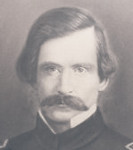
G.S. James
(1828 - 1862)
Home State: South Carolina
Education: South Carolina College (now U of SC)
Command Billet: Commanding Battalion
Branch of Service: Infantry
Before Sharpsburg
He was a member of the Euphemian Literary Society at Erskine Seminary (enrolled 1843), but "ran off" at age 18 to serve in Company E, Palmetto Regiment (Marshall's) in the Mexican War on 1 December 1846. He was Corporal by October 1847, and was appointed Sergeant Major of the Regiment on 1 December 1847. He mustered out 1 July 1848 at Mobile, AL and entered South Carolina College, where he was a senior in 1851, but left before graduating. He then went West, where he was a teacher in the Indian Territory. He was commissioned 2nd Lieutenant in the 4th US Artillery in June 1856 and 1st Lt in December 1857.
He resigned his US commission to go South on 1 February 1861, was commissioned Captain, Company C, First South Carolina Artillery, was in command of the Battery at Ft. Johnson, Charleston Harbor, and ordered the first (probably signal round) shot on Ft Sumter at 4:30 am, 12 April 1861.
He was appointed Major, 3rd South Carolina Battalion in December 1861, and Lieutenant Colonel and commanding officer on 2 February 1862.
On the Campaign
He was mortally wounded by gunshot to the chest in action at Fox's Gap on South Mountain on 14 September and died early the next morning in company with Capt C.F. Walcott of the 21st Massachusetts Infantry, who related:
I had an interesting conversation with a wounded rebel officer during the night. About midnight I heard a call for help, and going to the spot saw someone moving rapidly away from a man lying on the ground. The prostrate man told me that he was Lieutenant-Colonel James, of the 15th South Carolina [sic], that he was shot through the body when our men made the last assault, and had pretended to be dead, hoping that he should feel able to try to escape before morning, but found himself growing weaker, and knew that he should die. He said that he had called for help, because a prowling rascal had turned him over and taken his watch.He was (probably) relieved in command by Major William G. W. Rice.
As he was getting very cold, I covered him with a blanket, and gave him a drink of whiskey. As I sat by him he told me that when his regiment was ordered to cross the Potomac, the colonel [?] had refused to go, saying that the regiment had enlisted to defend the South and not to invade the North, but that he had sprung to the front, and telling the colonel that he was a coward, had called on the men to follow him, but had led them to their death, as he believed himself to be the only surviving officer of the regiment. The brave fellow died before morning.
The rest of the War
He was buried on the field by local resident Frank P. Firey. His remains were probably not returned to South Carolina.
References & notes
His basic Federal service from Heitman1. Details from Davis2 and the Euphemian Literary Society members list. His death on South Mountain from Walcott's History.3 His burial story from Brian Jordan's Unholy Sabbath (2012) citing the Confederate Veteran of February 1915. Further information from family genealogists. His picture from one posted by the South Carolina Confederate Relic Room & Military Museum.
Birth
01/16/1828; Laurens County, SC
Death
09/15/1862; Fox's Gap, MD
1 Heitman, Francis Bernard, Historical Register and Dictionary of the United States Army 1789-1903, 2 volumes, Washington DC: US Government Printing Office, 1903, Vol. 1, pg. 569 [AotW citation 15794]
2 Davis, Sam B., A History of the 3rd South Carolina Volunteer Infantry Battalion (James Battalion): 1861-1865 , Wilmington (NC): Broadfoot Publishing Company, 2009, pg. 403 [AotW citation 15991]
3 Walcott, Charles Folsom, History of the Twenty-first Regiment, Massachusetts Volunteers, in the War for the Preservation of the Union, 1861-1865, Boston: Houghton, Mifflin, 1882, pp. 191-192 [AotW citation 33693]